When it comes to cake decorating and professional baking, choosing the right piping bags can make a significant difference in efficiency, precision, and overall results. Piping bags are widely used for decorating cakes, cupcakes, cookies, pastries, and other baked goods. However, not every size is suitable for every application.
Piping bags are available in a wide range of sizes, from compact 8-inch bags for small decorating jobs to large 24-inch bags designed for commercial baking. Understanding the differences between these sizes can help bakers select the right product for their specific needs.
This guide explains the common piping bag sizes, their approximate capacities, recommended applications, and how to choose the most suitable size for different baking tasks.
What Are Piping Bags?
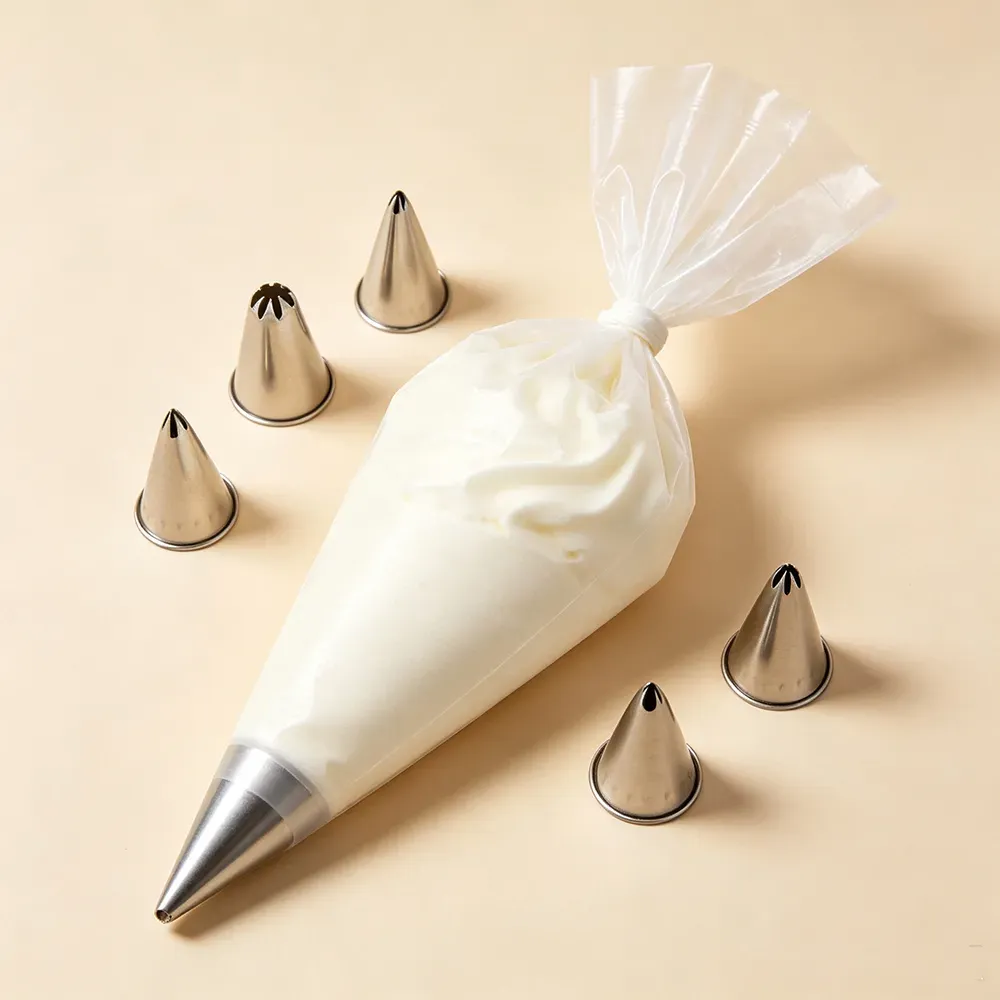
Piping bags are cone-shaped bags designed to hold and dispense materials such as buttercream, whipped cream, frosting, chocolate, icing, fillings, and sauces. A piping tip or nozzle can usually be attached to the narrow end of the bag to create different decorative patterns.
Depending on the application, piping bags can be manufactured from disposable plastic, reusable silicone, or other flexible materials. Disposable plastic piping bags are particularly popular in bakeries and food-service businesses because they are convenient, hygienic, and easy to use.
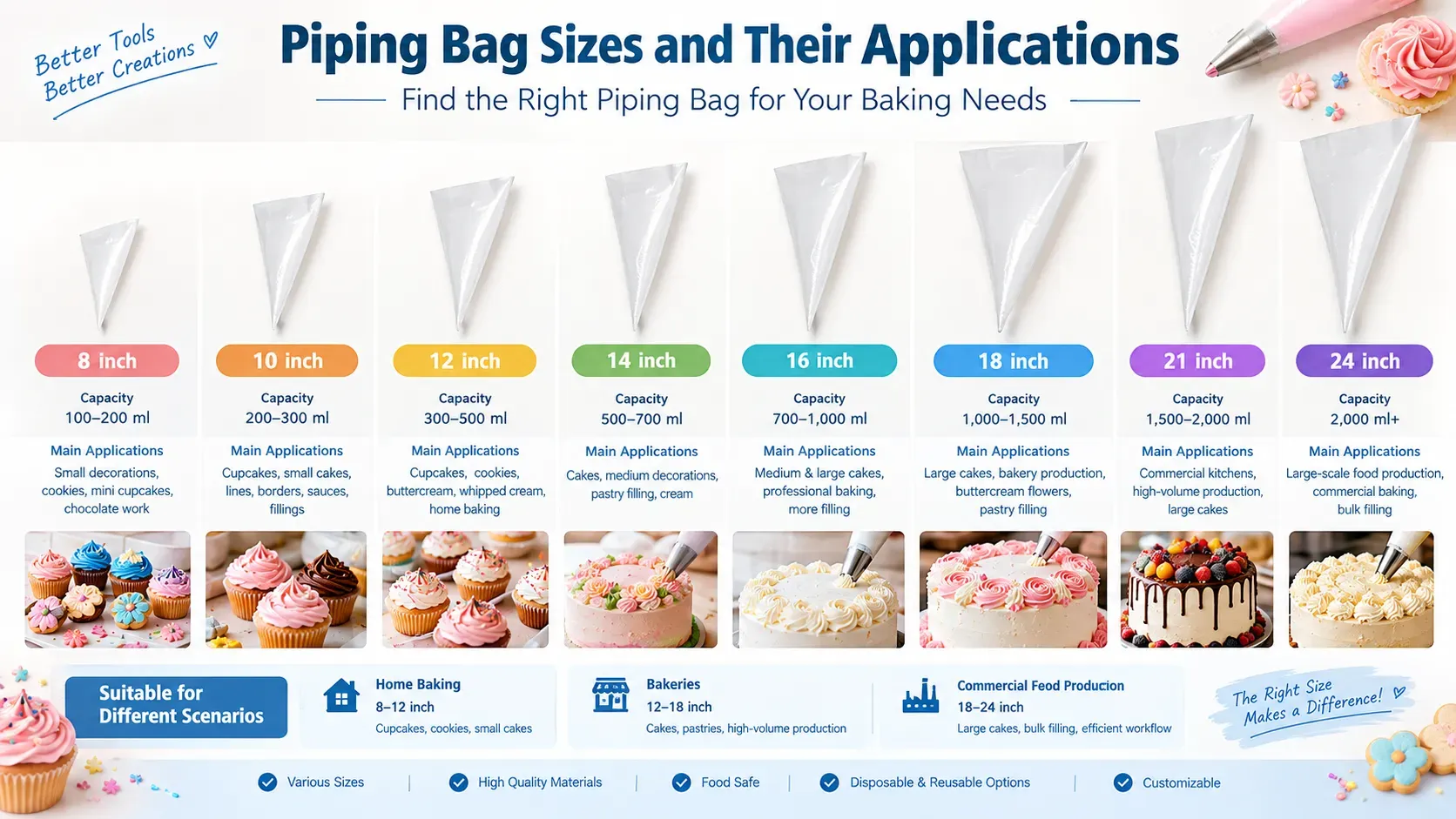
The size of piping bags is generally measured by their length in inches. Common options include 8-inch, 10-inch, 12-inch, 14-inch, 16-inch, 18-inch, 21-inch, and 24-inch bags.
Why Does Piping Bag Size Matter?
Choosing the correct size of piping bags is important because it affects how much filling can be loaded and how easily the bag can be controlled.
A bag that is too small may need to be refilled frequently, which can interrupt the decorating process. A bag that is too large may be difficult to control, especially when working on small cupcakes or detailed decorations.
The ideal size depends on the amount of material being used, the type of decoration, the user’s experience, and whether the bag is intended for household or commercial use.
For small decorating jobs, compact piping bags are usually easier to handle. For large cakes and commercial production, larger bags provide greater capacity and reduce the need for frequent refilling.
8-Inch Piping Bags
8-inch piping bags are among the smallest commonly available sizes. They are suitable for small quantities of frosting, chocolate, icing, or sauces.
These bags are particularly useful for simple decorating tasks such as adding small details to cookies, decorating mini cupcakes, writing on cakes, or applying small amounts of chocolate.
Because of their compact size, 8-inch piping bags are easy to control. They are a practical option for beginners, children, home bakers, and small decorating projects.
Common Applications
- Mini cupcakes
- Cookies
- Chocolate decoration
- Small cake details
- Writing and lettering
- Small amounts of icing
10-Inch Piping Bags
10-inch piping bags offer slightly more capacity while maintaining good control. They are suitable for home baking and small decorating jobs.
These bags can be used with different piping tips to create simple stars, rosettes, lines, borders, and other basic designs. They are also useful for dispensing sauces, fillings, and melted chocolate.
For bakers who do not need a large quantity of frosting at one time, 10-inch piping bags can provide a good balance between capacity and handling.
12-Inch Piping Bags
12-inch piping bags are one of the most versatile choices for home bakers and beginners. They provide enough capacity for many everyday decorating applications without becoming difficult to handle.
They are commonly used for cupcakes, cookies, cakes, whipped cream, buttercream, and basic pastry decoration.
For households that regularly bake cakes and cupcakes, 12-inch piping bags can be an excellent all-purpose option.
Recommended Applications
- Cupcake decoration
- Cookies
- Buttercream
- Whipped cream
- Cake borders
- Pastry filling
- Home baking
14-Inch Piping Bags
14-inch piping bags provide more capacity than 12-inch bags while remaining relatively easy to control. They are suitable for both home bakers and small professional bakeries.
These bags are often used for decorating medium-sized cakes and preparing larger amounts of frosting. They can also be used for filling pastries and applying cream-based fillings.
For users who find 12-inch bags too small but do not need a professional-size bag, 14-inch piping bags are a practical middle option.
16-Inch Piping Bags
16-inch piping bags are commonly used in professional baking environments. Their larger capacity allows bakers to load more frosting, cream, or filling at once.
They are suitable for medium and large cakes, detailed cake decoration, pastry production, and other applications where a larger quantity of material is required.
For bakeries producing multiple cakes every day, 16-inch piping bags can improve workflow efficiency because they reduce the frequency of refilling.
18-Inch Piping Bags
18-inch piping bags are a popular choice for professional bakers and commercial cake decorators. Their larger size makes them suitable for larger cakes and high-volume decorating tasks.
An 18-inch bag can hold significantly more frosting or filling than smaller bags, making it useful for large cake surfaces, borders, piping flowers, and other decorative work.
For businesses looking for a balance between capacity and usability, 18-inch piping bags are often one of the most practical choices.
Common Applications
- Large cakes
- Professional cake decorating
- Buttercream flowers
- Large amounts of frosting
- Pastry filling
- Bakery production
21-Inch Piping Bags
21-inch piping bags are designed for applications that require a higher filling capacity. They are commonly used in professional kitchens, bakeries, catering operations, and commercial food production.
The larger size allows users to work with larger quantities of cream, frosting, filling, or other food materials without stopping frequently to refill the bag.
These piping bags are especially useful when efficiency and continuous production are important.
24-Inch Piping Bags
24-inch piping bags are among the largest standard sizes. They are primarily intended for commercial baking, large-scale cake production, and applications requiring a substantial amount of filling.
Because these bags are longer and have a greater capacity, they are particularly suitable for experienced professionals who need to dispense large quantities of material efficiently.
However, larger piping bags can require more hand strength and control. They may not be the best choice for beginners or small decorating tasks.
Piping Bag Size Comparison
| Size | Approximate Capacity | Recommended Application |
|---|---|---|
| 8 inch | 100–200 ml | Small decorations and cookies |
| 10 inch | 200–300 ml | Cupcakes and small projects |
| 12 inch | 300–500 ml | Home baking and cupcakes |
| 14 inch | 500–700 ml | Cakes and medium-size decorating |
| 16 inch | 700–1,000 ml | Professional baking |
| 18 inch | 1,000–1,500 ml | Large cakes and bakeries |
| 21 inch | 1,500–2,000 ml | Commercial kitchens |
| 24 inch | 2,000 ml+ | Large-scale food production |
The capacities listed above are approximate because the actual capacity of piping bags depends on their width, shape, material thickness, and how they are filled.
Choosing Piping Bags for Home Baking
For home baking, smaller and medium-sized piping bags are generally easier to use.
If you mainly decorate cupcakes, cookies, and small cakes, 8-inch to 12-inch bags are usually sufficient. They provide good control and are easy to fill and handle.
For larger cakes or recipes requiring more frosting, 14-inch or 16-inch bags may be more convenient.
Home bakers should also consider whether disposable or reusable piping bags are more suitable for their needs. Disposable plastic bags are convenient for quick cleanup, while reusable bags can be washed and used repeatedly.
Choosing Piping Bags for Bakeries
Professional bakeries often require a wider range of piping bags because different products require different capacities.
For detailed decorating, smaller bags can provide better control. For large cakes and high-volume production, 16-inch, 18-inch, 21-inch, or 24-inch bags can help improve efficiency.
Many bakeries also choose disposable piping bags because they reduce cleaning time and provide a convenient solution for busy production environments.
Disposable Piping Bags vs. Reusable Piping Bags
Disposable piping bags are typically made from flexible plastic film. They are lightweight, hygienic, and convenient for high-volume food preparation.
Reusable piping bags are generally made from thicker materials such as silicone or coated fabric. They can be washed and reused multiple times.
The best option depends on the application. Disposable bags are often preferred for commercial kitchens where speed and hygiene are important, while reusable bags may be suitable for home bakers who want to reduce waste.
What Material Is Used for Piping Bags?
Plastic piping bags can be produced using different types of polyethylene materials, depending on the required flexibility, thickness, transparency, and strength.
Common materials include LDPE and other food-contact suitable plastic materials. The material should be selected according to the intended application and relevant food-contact requirements.
For professional products, manufacturers can offer different thicknesses to achieve the required combination of flexibility and puncture resistance.
Custom Piping Bags for Different Applications
Manufacturers can provide customized piping bags according to customer requirements. Customization options may include length, width, thickness, material, color, printing, opening size, and packaging.
For example, a bakery may require 12-inch bags for cupcakes and 18-inch bags for large cakes. A commercial food manufacturer may require 21-inch or 24-inch bags for high-volume production.
Custom sizes allow businesses to choose bags that match their production process instead of relying only on standard specifications.
How to Choose the Right Piping Bag Size
When selecting piping bags, consider the following factors:
1. Amount of Filling
Determine how much frosting, cream, icing, or filling needs to be loaded into the bag. Smaller amounts generally require smaller bags.
2. Type of Decoration
Detailed decorating often benefits from smaller bags because they provide better control. Large surfaces may require larger bags.
3. User Experience
Beginners may find smaller bags easier to control, while professional decorators can comfortably handle larger bags.
4. Production Volume
For commercial bakeries, larger piping bags can reduce interruptions caused by frequent refilling.
5. Material and Thickness
The material should provide sufficient flexibility and strength for the intended application. Thicker bags can provide additional durability, while thinner bags may offer greater flexibility.
Conclusion
Selecting the right piping bags depends on the quantity of filling, decorating technique, production volume, and user’s experience. Smaller sizes such as 8-inch, 10-inch, and 12-inch bags are ideal for cupcakes, cookies, and home baking. Medium sizes such as 14-inch and 16-inch bags are suitable for cakes and professional decorating, while 18-inch, 21-inch, and 24-inch bags are better suited to large cakes and commercial production.
For manufacturers and suppliers, offering multiple sizes allows customers to select the most suitable product for their specific applications. Whether you need small disposable bags for detailed cake decoration or large-capacity bags for commercial bakery production, choosing the correct size can improve efficiency, control, and overall decorating results.