Clear Plastic Mattress Bags are durable protective packaging bags specially designed for mattresses during manufacturing, storage, transportation, moving, and retail display. Made from high-quality polyethylene (PE) materials such as LDPE (Low-Density Polyethylene), these transparent mattress bags provide excellent protection against dust, moisture, dirt, scratches, and handling damage while allowing easy product identification.
With their lightweight structure, strong tear resistance, and customizable sizes, clear plastic mattress bags are widely used by mattress manufacturers, furniture suppliers, logistics companies, moving services, and retailers. They are available in flat bags, side-seal bags, gusset bags, and roll bags for manual or automated packaging operations.
What Are Clear Plastic Mattress Bags?
Clear plastic mattress bags are continuous polyethylene (PE) bags connected together on a roll. Instead of supplying individual bags, manufacturers wind hundreds of bags onto a single roll with perforations between each bag.
During production, an automatic packaging machine feeds the roll continuously, separates each bag at the perforation, inserts the mattress, seals the opening, and prepares the packaged mattress for shipment.
Compared with manually placing mattresses into individual bags, roll bags provide a much faster and more reliable packaging method.
 |  |
Why Do Mattress Manufacturers Prefer Roll Bags?
Modern mattress factories often produce hundreds or even thousands of mattresses every day. Manual packaging can quickly become a production bottleneck.
Using roll bags offers several significant advantages.
Higher Packaging Speed
Automatic machines continuously pull bags from the roll without interruption.
Depending on the packaging equipment, production speeds may reach:
- 150–300 mattresses/hour (semi-automatic)
- 300–600 mattresses/hour (fully automatic)
- Even higher for customized production lines
Continuous feeding minimizes downtime and keeps the packaging line running efficiently.
Reduced Labor Costs
Instead of multiple workers manually opening bags and inserting mattresses, one operator can supervise an automated packaging line.
This dramatically lowers labor expenses while reducing operator fatigue.
Consistent Packaging Quality
Roll bags are manufactured with precise dimensions.
Automatic machines ensure:
- Straight bag positioning
- Uniform sealing
- Consistent appearance
- Reduced packaging errors
This consistency is especially important for export products and retail presentation.
Better Production Efficiency
Because bags are connected together on a roll, operators do not need to constantly replace individual bags.
This reduces machine stops and increases overall factory productivity.
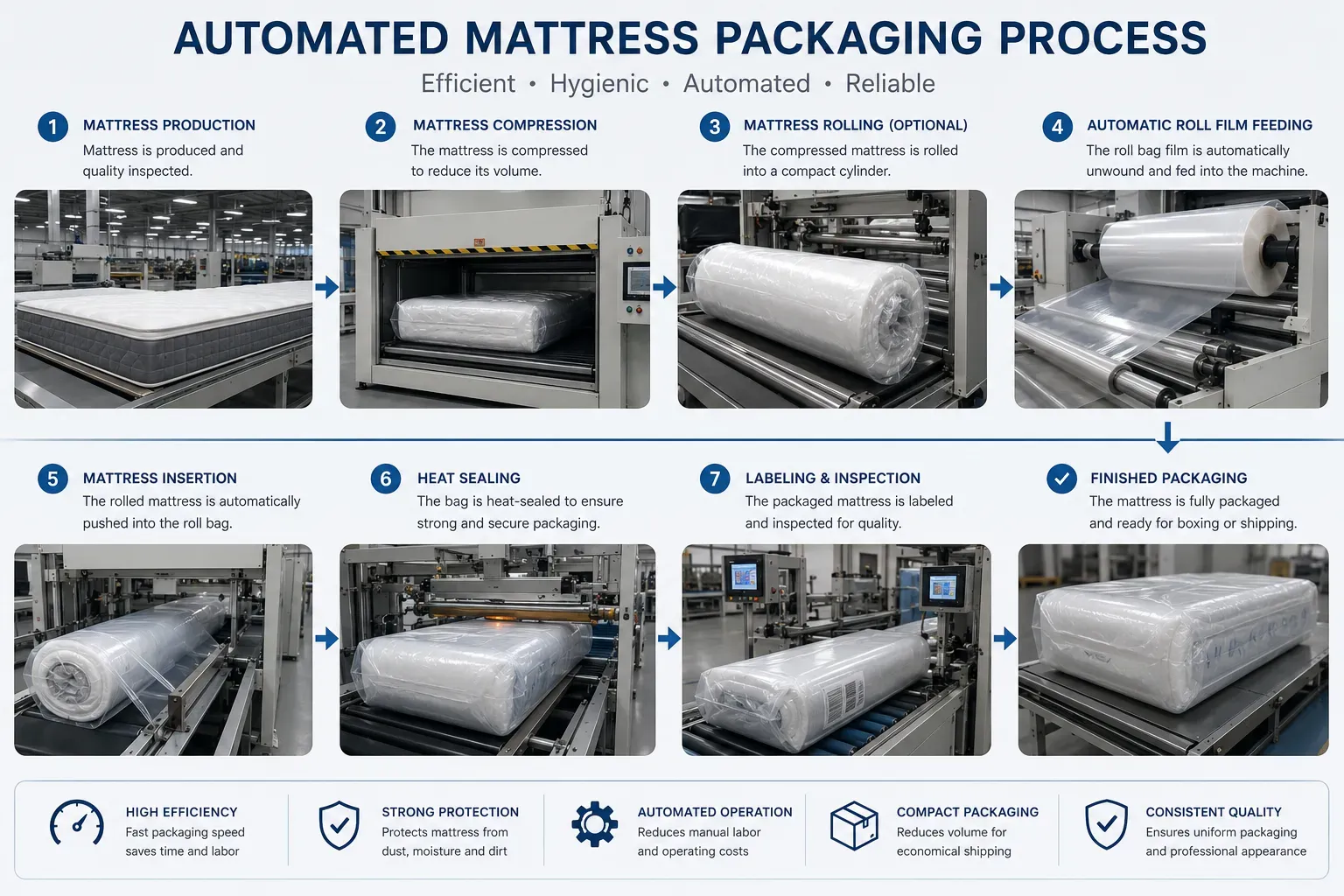
How Does Automatic Mattress Packaging Work?
A fully automated mattress packaging line typically follows several sequential steps.
Step 1: Mattress Production
After the mattress core is assembled, the outer fabric cover is sewn and inspected.
Quality control personnel verify dimensions, appearance, stitching quality, and cleanliness before packaging.
Step 2: Mattress Compression
Many foam and hybrid mattresses are compressed using a hydraulic compression machine.
The mattress thickness is greatly reduced, making transportation much more economical.
Compression also prepares the mattress for rolling.
Step 3: Mattress Rolling (Optional)
For bed-in-a-box products, the compressed mattress is rolled into a compact cylinder.
Rolling further reduces shipping volume and allows the mattress to fit into cartons or shipping tubes.
Traditional spring mattresses may skip this step.
Step 4: Automatic Roll Bag Feeding
This is where clear plastic mattress roll bags become essential.
The packaging machine automatically:
- Unwinds the roll
- Pulls the next bag forward
- Opens the bag
- Positions it correctly
- Synchronizes with the conveyor system
No manual bag handling is required.
Step 5: Mattress Insertion
The compressed mattress is pushed or conveyed directly into the plastic bag.
Because polyethylene film has excellent flexibility and low friction, insertion is smooth even for large king-size mattresses.
Step 6: Heat Sealing
Once the mattress is inside, the machine seals the bag opening using controlled heat and pressure.
A high-quality seal protects the mattress from:
- Dust
- Moisture
- Dirt
- Shipping contamination
Proper sealing also prevents accidental opening during transportation.
Step 7: Labeling and Inspection
Finished packages may receive:
- Barcode labels
- Product information
- Shipping labels
- Customer branding
- QR codes
Operators perform a final inspection before cartons or pallets are prepared.
Materials for Clear Plastic Mattress Bags
Most clear mattress packaging bags are manufactured from polyethylene materials.
Common options include:
LDPE (Low-Density Polyethylene)
Advantages:
- Excellent transparency
- Soft texture
- Easy sealing
- Good flexibility
Ideal for premium mattress packaging.
LLDPE (Linear Low-Density Polyethylene)
Advantages:
- Higher tensile strength
- Better puncture resistance
- Improved tear resistance
Suitable for heavy mattresses.
LDPE + LLDPE Blend
It balances:
- Transparency
- Toughness
- Flexibility
- Seal strength
- Cost efficiency
Most export mattress bags use this material structure.
Common Thickness Options
The appropriate film thickness depends on mattress size and transportation requirements.
Typical specifications include:
| Thickness | Typical Application |
|---|---|
| 30–40 microns | Lightweight foam mattresses |
| 50–70 microns | Standard residential mattresses |
| 80–100 microns | Heavy hybrid mattresses |
| 120 microns and above | Industrial or export protection |
Thicker films provide greater puncture resistance but also increase material costs.
Optional Features Available
Manufacturers often customize mattress roll bags with additional features, including:
- Printed company logos
- Recycling symbols
- Vent holes
- Perforated tear lines
- Anti-static additives
- UV-resistant materials
- Custom bag dimensions
- Center-fold film structures
These options help improve production efficiency and strengthen brand recognition.
Which Types of Mattresses Use Roll Bags?
Roll bags are suitable for many mattress categories, including:
- Memory foam mattresses
- Latex mattresses
- Pocket spring mattresses
- Hybrid mattresses
- Foam mattresses
- Gel mattresses
- Bed-in-a-box products
- Hotel mattresses
- Export mattresses
Even oversized mattresses can be packaged automatically by adjusting machine settings and bag dimensions.
Why More Global Mattress Manufacturers Are Choosing Automated Roll Bag Packaging
As labor costs continue to rise and production volumes increase, automation has become a necessity rather than a luxury.
Clear plastic mattress roll bags allow manufacturers to achieve:
- Faster production
- Lower packaging costs
- Better product protection
- Improved packaging consistency
- Reduced material waste
- Higher customer satisfaction
For exporters, automated packaging also improves shipping efficiency by creating compact, uniform packages that are easier to palletize and transport.
Yes, clear plastic mattress bags are commonly supplied in roll form for automatic packaging systems, especially in modern mattress factories producing compressed or bed-in-a-box products. Roll bags integrate seamlessly with automated packaging equipment, enabling continuous feeding, rapid bagging, reliable heat sealing, and consistent packaging quality.
Compared with manual packaging, roll bags significantly improve efficiency, reduce labor costs, and provide superior protection throughout storage and transportation. As automation becomes increasingly widespread, clear plastic mattress roll bags have become the industry standard for mattress packaging worldwide.
For manufacturers seeking higher productivity and dependable packaging performance, investing in high-quality custom mattress roll bags is a practical and cost-effective solution.