Resealable bags are widely used for food packaging, retail products, electronics, hardware, clothing accessories, medical supplies, and many other products. While most custom printing is usually placed on the main body of the bag, some manufacturers also print text, logos, patterns, or functional information along the edge near the zipper or resealable closure.
Printing on the edge of resealable bags is not simply a decorative choice. This area can provide additional space for branding, product identification, usage instructions, warnings, and traceability information without taking away too much space from the main product display area.
For brands and packaging buyers, understanding the purpose of edge printing can help them choose a more practical and professional packaging solution.
What Is Edge Printing on Resealable Bags?
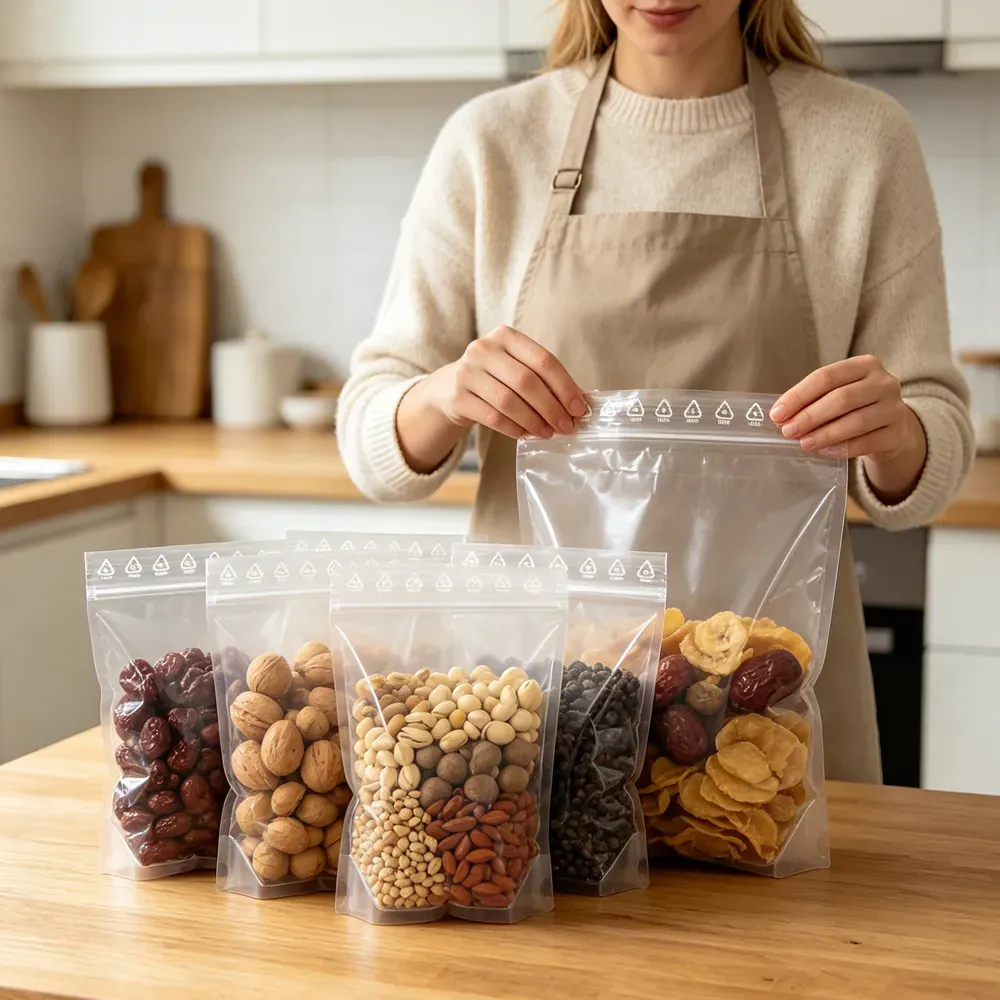
Edge printing refers to printing information or graphics in the area close to the top edge, zipper, or resealable closure of a plastic bag. Depending on the bag structure and printing requirements, the printed area may be located above the zipper, below the zipper, or along the upper edge of the bag.
Common printing content includes:
- Brand logos
- Company names
- Product names
- Resealable instructions
- Storage instructions
- Warning information
- Batch or product codes
- Decorative patterns
- Recycling symbols
- QR codes or barcodes
- Promotional messages
The exact printing position depends on the bag design, film structure, zipper construction, printing method, and intended application.
Why Do Brands Print on the Edge of Resealable Bags?
1. Additional Branding Space
One of the most important purposes of edge printing is to create additional branding space.
The main body of a resealable bag may already contain product images, descriptions, ingredients, instructions, and other information. Adding a logo or brand name near the zipper provides another visible branding area without overcrowding the main design.
For example, a food brand may print its logo directly below the zipper. Every time the consumer opens or closes the bag, the brand name remains visible.
This can help create a more consistent packaging appearance and improve brand recognition.
2. Clearly Communicate the Resealable Function
Edge printing can also explain how the packaging should be used.
Manufacturers can print simple messages such as:
- “Resealable”
- “Press to Seal”
- “Open & Reseal”
- “Zip to Close”
- “Keep Sealed”
- “Close After Use”
These instructions are particularly useful for products that need to be opened and closed repeatedly.
For example, snacks, dried fruit, pet treats, coffee, nuts, seeds, and household products may be used over several days or weeks. Printing a simple instruction near the zipper helps consumers understand the function of the packaging.
3. Improve Consumer Convenience
The location of the printing is also important.
When instructions are placed near the resealable closure, consumers can associate the information directly with the action they need to perform. Instead of searching through the packaging for instructions, they can see the information immediately when opening or closing the bag.
For products intended for repeated use, this can make the packaging more intuitive.
4. Provide Storage Instructions
Resealable bags are frequently used for products that need to be protected from moisture, air, dust, or contamination after opening.
The edge area can therefore be used for short storage messages such as:
“Keep Dry”
“Store in a Cool Place”
“Keep Refrigerated After Opening”
“Reseal After Each Use”
“Keep Away From Direct Sunlight”
These messages are especially useful for food, agricultural products, pet food, and certain household products.
Because the text is located close to the closure, consumers can easily associate the instruction with the need to reseal the bag after use.
5. Separate Functional Information From Product Information
The main body of packaging usually needs to communicate important product information.
For example, a food bag may need to display:
- Product name
- Ingredients
- Nutrition information
- Net weight
- Product images
- Manufacturer information
- Certification marks
If all additional instructions are placed on the main panel, the design can become crowded.
Printing near the edge provides another area for functional information. This allows designers to organize the packaging more effectively.
The main panel can focus on branding and product presentation, while the edge area can communicate short functional messages.
6. Support Product Identification
For industrial and commercial packaging, edge printing can be used for product identification.
For example, a resealable bag for electronic components may contain:
Product No.: ABC-1258
Size: 50 × 70 mm
Batch: 2026-09
Similarly, hardware suppliers may use edge printing to identify screws, washers, connectors, or other small components.
This can make inventory management easier, particularly when many similar products are packed in different resealable bags.
7. Add Warning and Safety Information
Certain products require specific handling instructions or warnings.
The edge of a resealable bag can provide additional space for messages such as:
- “Keep Out of Reach of Children”
- “Not for Direct Food Contact”
- “Do Not Reuse”
- “Keep Away From Heat”
- “For Industrial Use Only”
The exact wording should be determined according to the product, market, applicable regulations, and customer’s compliance requirements.
For regulated products, printing space should be planned together with the manufacturer’s technical and compliance teams rather than added only as a decorative element.
8. Create a More Professional Packaging Design
Edge printing can also improve the overall appearance of a resealable bag.
A simple transparent ziplock bag can look relatively basic. Adding a repeating logo, colored line, pattern, or short brand message near the top edge can give the packaging a more customized appearance.
For retail packaging, this can help create a consistent visual identity across different product sizes.
For example, a company selling nuts, dried fruit, coffee, or pet treats could use the same logo position and graphic style across several bag sizes.
9. Improve Brand Recognition After Opening
Another advantage is that the branding can remain visible even after the bag has been opened.
When consumers open a resealable bag, the original top portion may be folded, rolled, or partially obscured. Strategic edge printing can help maintain brand visibility around the closure area.
This is particularly useful for packaging that is stored on shelves, in refrigerators, kitchen cabinets, or warehouses after opening.
10. Support Custom Packaging for Different Applications
Edge printing can be customized according to the application.
Food Packaging
Food manufacturers can use edge printing for:
- Brand logos
- Resealing instructions
- Storage information
- Opening instructions
- Product identification
Electronics Packaging
For electronic components, edge printing may include:
- Part numbers
- Model numbers
- Product specifications
- Batch numbers
- Handling instructions
Clothing and Accessories
For clothing accessories, edge printing can include:
- Brand name
- Product code
- Size
- SKU
- Care information
Hardware Packaging
For screws, fasteners, fittings, and small tools, edge printing can provide:
- Product name
- Size
- Quantity
- Model number
- Batch information
What Should Be Considered Before Edge Printing?
Although edge printing offers many advantages, the printing position should be carefully designed.
First, the printed area should not interfere with the zipper or resealing mechanism. If the printing extends into the sealing area, it may affect the appearance or performance of the closure.
Second, the artwork should consider the final dimensions of the bag. The usable printing area can vary depending on the zipper position, sealing margin, gusset, bag width, and production process.
Third, the manufacturer should confirm whether the requested printing position is technically suitable for the selected film material and printing method.
For example, different materials such as PE, PP, PET/PE, PA/PE, CPP, and laminated films may have different printing and sealing characteristics.
How Do Manufacturers Control Printing Quality?
During production, manufacturers normally need to control several factors, including:
- Printing registration
- Color consistency
- Ink adhesion
- Printing clarity
- Position accuracy
- Film surface treatment
- Zipper alignment
- Heat-sealing performance
For customized resealable bags, the printing artwork should be confirmed before mass production.
A professional packaging manufacturer can provide a digital artwork proof or physical sample so that the buyer can confirm the printing position, colors, text, and overall appearance.
Is Edge Printing Suitable for All Resealable Bags?
Not necessarily.
Whether edge printing is suitable depends on the bag structure, zipper type, printing requirements, product application, and manufacturing process.
For simple storage bags, printing on the main body may be sufficient. For branded retail packaging or products requiring specific instructions, edge printing can provide useful additional space.
The key is to balance functionality, appearance, production feasibility, and cost.
Conclusion
Printing on the edge of resealable bags has several practical purposes. It can provide additional branding space, communicate resealing instructions, display storage information, identify products, provide warnings, and create a more professional packaging appearance.
For B2B packaging buyers, edge printing should be considered as part of the overall bag design rather than simply an additional decorative feature. The printing position should work together with the zipper, sealing area, film material, bag dimensions, and intended application.
Whether you need custom printed resealable bags, custom ziplock bags, food-grade resealable bags, or industrial resealable packaging, the printing layout can be customized according to your product requirements.
A well-designed resealable bag combines functional closure performance, clear printing, suitable materials, and practical product information to create packaging that is convenient for consumers and effective for brands.